
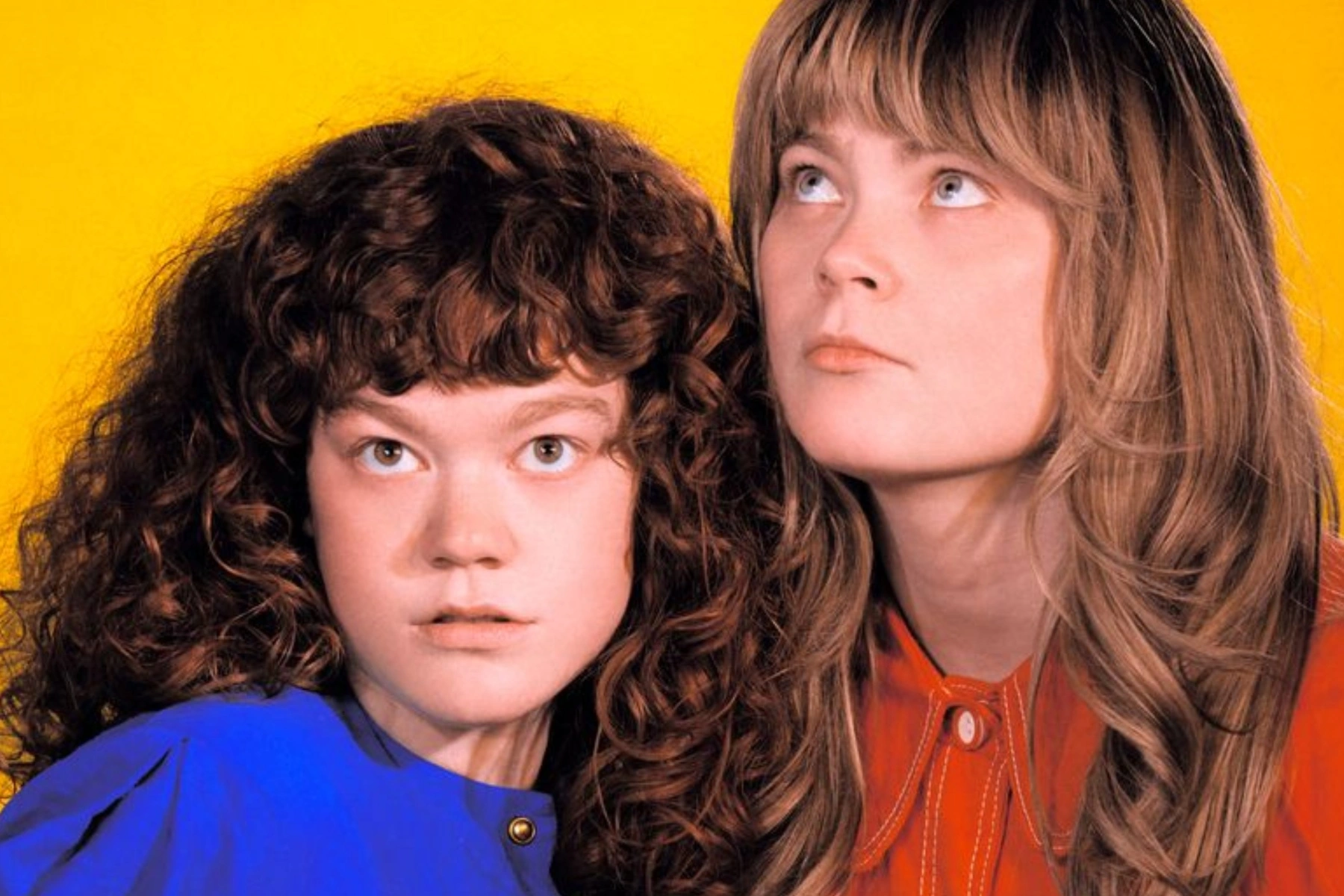
Gritty. Unbridled. Raw. These are just a few words of many you can use to describe sister duo Girl Tones on the release day of their debut album Precious.
Hailing from Bowling Green, KY, Kenzie Shultz and Laila Crow weren’t always seeking out the rockstar life. In fact, they cut their teeth as classical musicians, studying cello and piano. Luckily, transitioning into electric guitar, drums, and gritty riot grrrl-esque vocals was seamless.
The duo effortlessly balances delicate indie melodies with fierce, grunge-laced sonics across all ten of their tracks. It’s nothing short of a dazzling and perfect debut project. And it is well worth your time to catch them on their debut headlining tour.
idobi Radio had the chance to sit down with Kenzie and Laila ahead of their fall shows and chat about Cage The Elephant‘s Brad Shultz’s impact on bringing their vision to life, how their classical training lends itself to rock ‘n’ roll, how grief fueled the creation of their title track, and more.
How did producer Brad Shultz help bring your debut album to life?
Laila: Before we started working on this album, we had tried to go into the studio just like on our own and record, and we were just never really able to achieve the sound we were wanting. We didn’t realize at the time that writing a song and performing it versus writing a song and then recording it are two completely different animals.
Things that translate live do not translate the same to a record, so it is almost two different versions of the song that you have to create and get familiar with. We didn’t know that until we went into the studio with Brad, and he came in and was like, “We should change it to make it a little more structured.” Live you can be a little more loose with it depending on the energy that the crowd is giving. Parts can get extended, new parts can be added, but then when you start listening to it in a recording, it’s got to be a little more clear and concise.
Just learning how to adjust the song from live to in-studio was something that Brad was very helpful in helping us learn how to understand. When we just tried doing it on our own, we just didn’t know that, so we didn’t do it. But I mean, he’s been doing it, so he knew what we were trying to accomplish. It’s good to have that outside view, too.
You guys both have extensive classical music training. How did that come into the creation of Precious?
Kenzie: I’d say it was a huge thing, because the title track “Precious” is obviously a piano song. That kind of goes back to having Brad with us and helping us make those decisions in songs. We did not expect that song to be a piano song, and that was his idea. He saw that potential in us. We do play rock music, a lot of people know us as that, but he was pushing us in that direction to show that we are a little more diverse in our sound than that.
So it was really him who brought that up and was like, “Let’s do piano, let’s add strings.” That’s something we always wanted to do anyways, so it just kind of worked out to highlight both the heaviness that we do and then also the light, strings, acoustic guitar, all that stuff.
It was very important for us to learn classical first, I feel like, because it taught us all the different scales and music theory—all that stuff that is kind of boring, but it is pretty important in writing songs. That really helped us as well.
It is truly beautiful that the writing on the cover of your record is your late Abuelita’s. Are there are any other ways that she came into your album process or the project as a whole?
Laila: Yeah. She was always very supportive of us, no matter what we would do. We’re very lucky in that we come from such a supportive family that have always encouraged us to kind of venture out and pursue whatever we want to do.
Kenzie: If you had known my Abuelita, you’d know the music she listened to versus what we played was very different! And so for her to actually come to our shows… it was kind of funny seeing her in the crowd, but it was very sweet. She didn’t even care what kind of music was; she was just proud to even be there, you know? So it was really special.
Obviously there are many, many themes across this album. From talking about family, of course, all the way to feminine rage. What anecdotes or personal experiences helped you create some of these tracks?
Kenzie: I think a lot of our songs, like you said, has a lot of rage, but I do feel like some of the rage is in ways [of] self-reflection, and realizing that it’s your responsibility to kind of work your shit out.
And then the slower songs like “Mirror” and “Precious,” those are songs of grief. It is about just that whole process of going through grief. So, I think a lot of people probably will relate to what we’re saying in those songs, and maybe it’s a way for them to cope with things. Because I know for me, “Precious” was written when our Abuelita passed away around four years ago, but it wasn’t until this year when we lost our Papa that the song “Mirror” was written, and that’s about the loss of him.
If you’re going through that, maybe it’s something that you don’t know how to express it, maybe these songs can help you express how you’re feeling. Maybe this will be cathartic.
Family obviously plays a part in your songwriting, and you yourselves are a sibling duo. How does being sisters impact your creative process?
Laila: Yeah, I think it’s just been the best-case scenario for us because we have the same image or idea, and we just align on so much that it is helpful for us to kind of divide and conquer, if that makes sense. We know each other’s strengths and are able to pick up the slack where the other person might need help, and so we’re able to find that natural rhythm. A lot of kind of what you were saying is a lot unspoken, too, which I think is very helpful because we kind of get more done that way.
Yeah, I think a lot of that comes from obviously from us being sisters and having that kind of nonverbal communication, but too, growing up learning classical. You know, there’s a lot of… when we were playing in an orchestra setting, there’s a lot of: you have to be in time and in tune with everyone else around you. So you get really good at reading nonverbal cues and body language.
Kenzie: Being able to be honest without having the fear of actually hurting someone’s feelings, you know what I mean? Of course there could be drama or whatever, but at the end of the day, it is your sibling, you love each other, and you know it’s not the end of the world.
Laila: At the end of the day, we’re still family, and that’s going to be more important than anything else, so it’s never that serious.
Whether it was lyric writing or production techniques, what really pushed you the most creatively for this debut album?
Laila: Yeah. I think probably the title track, honestly. We had a lot of back-and-forth on that, and it went through a lot of changes and structure readjustments. I think that was the one that probably took us the longest, and that we really had to sit on. I would say that one for me, at least.
Kenzie: And I would say probably “Mirror,” too, because it really pushed my vocals in that one on how high I could sing. Technically, for my vocal range that was kind of difficult for me, and I’m pretty sure we had to do a couple more takes than usual on that. And then also, for some of the heavier songs, I started using a baritone, which was new to me! So that was really fun.
This interview was edited for length and clarity.
